
 Dr. Shikha Mishra
From Joshimath to Dharali: CM Dhami’s Leadership in Uttarakhand’s Toughest Disasters

Dr Shikhha Mishra
Editor, Lead Reporting (English Weekly)
Ph.D. & M.Phil. in Journalism and Mass Communication
Editorial experiences with—The Indian Express, The Pioneer & Hindustan Times
A seasoned journalist, senior media educator, Media & Communication Researcher
Author and Patent Holder
As Uttarakhand celebrates the 26th anniversary of its statehood, the occasion cannot be complete without acknowledging the seminal work of Chief Minister Pushkar Singh Dhami over the past five years. In a state built to confront natural calamities—from tunnel collapses, flash floods and landslides to forest fires and avalanches—his handling of disasters with utmost urgency, promptness and endurance has emerged as a defining quality of leadership. Uttarakhand has always needed a leader who is not only visionary but also capable of acting decisively in moments of adversity. CM Dhami’s “first responder” approach has shown that effective governance is measured not merely by announcements, but by swift action, ground presence and the ability to protect lives when every second matters. Equally significant, his stable five-year tenure has brought an end to the frequent changes of Chief Minister that once fuelled political uncertainty and hindered the state’s momentum. This continuity has enabled smoother implementation of developmental projects, stronger administrative coordination and a more focused pursuit of Uttarakhand’s holistic growth.

A state built for crisis
Uttarakhand’s geography makes disaster governance unusually demanding: steep slopes, fragile roads, remote pilgrim routes, glacial hazards and extreme weather can isolate communities within hours. Dhami retained direct charge of disaster management and rehabilitation when his government was formed, signalling that crisis response would remain a core executive responsibility rather than a departmental afterthought.
That institutional approach became visible across his tenure. The state combined its own machinery—SDRF, police, district administration and the State Emergency Operations Centre—with the Army, ITBP, NDRF, Air Force, BRO and central scientific institutions whenever the scale of an emergency demanded it.
Joshimath: prevention before catastrophe
The Joshimath land-subsidence crisis of January 2023 was an early test of Dhami’s government. Cracks appeared in hundreds of buildings, and the administration moved to identify unsafe zones, evacuate residents and arrange temporary shelter before the situation could become a mass-casualty event.
Dhami personally inspected the affected area and ordered evacuation from danger zones. The government provided displacement assistance of Rs 4,000 per family per month for at least six months, arranged accommodation for affected residents, deployed NDRF and SDRF teams, and brought in experts from NDMA, GSI, IIT Roorkee, Wadia Institute and other institutions to guide both immediate safety measures and longer-term reconstruction.
The episode demonstrated an important principle: disaster management is not only rescue after an event, but also early evacuation, scientific assessment and sustained communication with frightened residents. By January 2023, the state had reported 863 damaged structures and shifted 296 families comprising 995 people to safer locations.
Silkyara: coordination that saved 41 lives
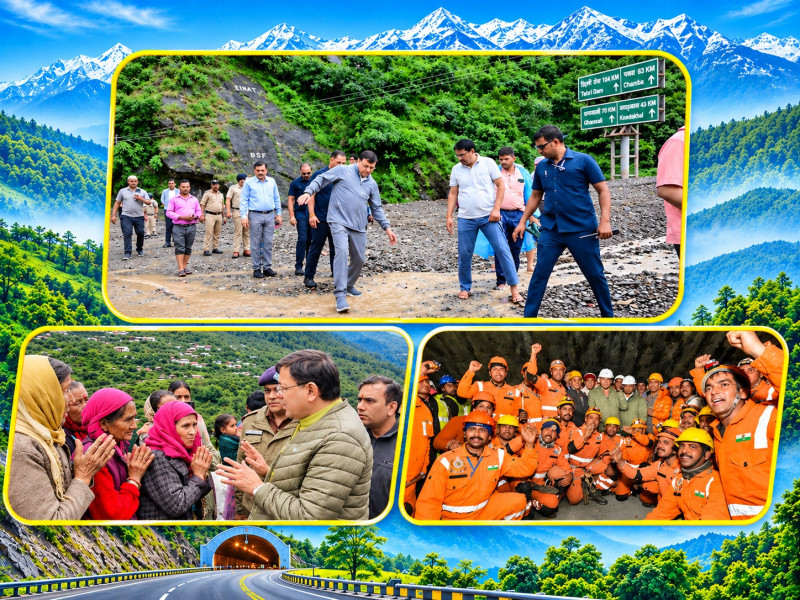
The Silkyara tunnel collapse in Uttarkashi in November 2023 became the defining rescue operation of Dhami’s tenure. Forty-one workers were trapped after a portion of the under-construction tunnel on the Yamunotri National Highway collapsed; the operation lasted 17 days and required extraordinary technical and administrative coordination.
Dhami monitored the operation continuously and worked in close alignment with the Prime Minister’s Office, central agencies, the Army, NDRF, SDRF, BRO and Indian and international tunnelling experts. The eventual safe evacuation of all 41 workers was not a single heroic act but the result of disciplined command, multiple rescue strategies, sustained logistics and refusal to abandon the trapped men.
The Chief Minister later described the mission as proof that strong willpower, effective leadership and scientific capability can overcome even the toughest challenges. More significantly, his government used the experience to strengthen risk assessment, scientific techniques, AI-based warning systems and inter-agency coordination.
Kedarnath: protecting pilgrims at scale
In August 2024, heavy rainfall triggered landslides along the Gauri Kund–Kedarnath axis, stranding thousands of pilgrims on one of India’s most sensitive pilgrimage corridors. The response required evacuation through damaged routes, helicopter support and ground teams operating in dangerous terrain.
NDRF ultimately evacuated 14,563 stranded pilgrims, while SDRF teams worked alongside district authorities to move people to safety. Dhami reviewed the operation virtually with the Rudraprayag District Magistrate and Superintendent of Police, directed continued evacuation and ensured that helicopter services resumed as conditions allowed.
The scale matters: more than 12,000 pilgrims had already been evacuated by the sixth day of operations, despite poor visibility and repeated disruption to air services. This was a test of crowd management, route restoration, medical preparedness and administrative stamina.
Mana avalanche: speed in extreme terrain
In late February 2025, an avalanche struck a BRO camp near Mana village in Chamoli, burying 54 workers in containers and a shed. The rescue operation unfolded in heavy snow, with blocked roads, a snow-covered helipad and severe communication and power disruptions.
Dhami conducted an aerial survey, reviewed operations from the State Emergency Operations Centre and pressed for the deployment of modern tools including ground-penetrating radar, thermal-imaging cameras and victim-locating cameras. Army, ITBP, Air Force, NDRF, SDRF, police, health and disaster-management personnel worked together in a nearly 60-hour operation.
Forty-six workers were rescued alive; eight died. The outcome was tragic, but the rescue itself showed the value of immediate multi-agency deployment, air evacuation and continuous political-administrative oversight in an environment where every hour can determine survival.
Dharali: a model of rapid response
The Dharali–Harsil disaster of 5 August 2025 was perhaps the clearest demonstration of Dhami’s crisis-management method. A cloudburst-triggered flash flood devastated the Uttarkashi area, damaging lives, property, roads and connectivity in a remote high-altitude zone.
On receiving reports while he was in Tirupati, Dhami immediately ordered rescue and relief on a war footing, cancelled his tour and reached the State Emergency Operations Centre in Dehradun the same evening. By that evening, more than 130 people had already been rescued; the government appointed a nodal officer, deployed senior police leadership and hundreds of personnel, and released Rs 20 crore from the State Disaster Response Fund.
The next day, despite adverse weather, Dhami reached the affected area, met displaced families, reviewed relief camps and instructed officials to prioritise evacuation, food, water, shelter and medical care. The Centre deployed Chinook and Mi-17 helicopters; heavy equipment was airlifted where roads were blocked, while temporary bridges, power restoration and communication recovery began in parallel.
Within five days, more than 1,300 pilgrims and local residents were safely evacuated, with over 1,000 personnel from SDRF, NDRF, the Army, police, ITBP, BRO and other agencies engaged in the operation. The Governor later described Dhami’s leadership as a model example of crisis management and directed that the response be documented to strengthen future preparedness.
A governance legacy
Dhami’s five years have shown that effective disaster governance in Uttarakhand requires more than announcements after a tragedy. It demands pre-positioned capacity, clear command, trust between state and central agencies, scientific input, rapid logistics and visible political accountability.
From Joshimath’s preventive evacuation to Silkyara’s 17-day rescue, from the mass evacuation at Kedarnath to the high-altitude avalanche operation at Mana and the large-scale Dharali response, Dhami’s government has repeatedly converted a fragmented emergency landscape into a coordinated rescue effort. The loss of life in some disasters is a sober reminder that Himalayan risks cannot be eliminated, but the ability to save lives, restore connectivity and support affected families has become a measurable strength of his administration.
As Uttarakhand faces an increasingly volatile climate and growing pressure on Himalayan infrastructure, the challenge ahead is to move from exceptional crisis response to durable prevention: stronger early-warning systems, safer construction, better route planning and community-level preparedness. Dhami’s record suggests a government that has learned, under pressure, that in the mountains the first duty of governance is to protect life.